

Different cultures, one sky — exploring the many ways humans interpret the stars
Though astrology is often associated with Western horoscopes and zodiac signs, nearly every major civilization in history has developed its own system for reading the stars. These traditions may differ in methods, symbols, and focus, but all share a common intention: to connect human life with the cosmos and find meaning in celestial rhythms.
In this article, we explore and compare four major astrological systems: Western, Vedic, Chinese, and Mayan astrology.
🌞 Western Astrology
Origin: Hellenistic Greece (influenced by Babylon, Egypt, and Rome)
Zodiac system: Tropical (based on the seasons)
Chart focus: Psychological insight, self-development, and timing
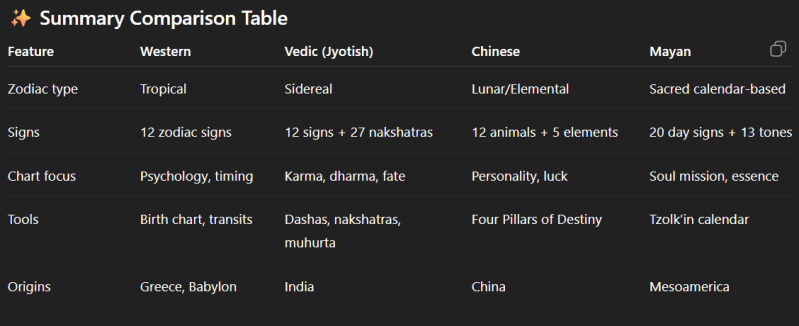
Western astrology is the most widely known system in modern culture. It divides the sky into 12 zodiac signs, based on the apparent path of the Sun through the sky during the year. Each sign corresponds to a 30-degree segment of the 360-degree ecliptic, beginning with Aries at the Spring Equinox.
A Western natal chart includes:
-
The Sun, Moon, and eight planets
-
Twelve houses, representing different areas of life
-
Aspects, which describe relationships between planets
-
Points like the Ascendant, Midheaven, Chiron, and lunar nodes
Western astrology is tropical, meaning it aligns the zodiac signs with the seasons rather than the constellations. For example, Aries always begins around March 21, regardless of where the constellation actually is in the sky.
Focus: Western astrology emphasizes personality, psychological growth, life cycles (like Saturn Return), and transits. It is often used as a tool for self-awareness, decision-making, and timing.
🪷 Vedic Astrology (Jyotish)
Origin: Ancient India (circa 1500 BCE)
Zodiac system: Sidereal (based on fixed stars)
Chart focus: Karma, life purpose, destiny, and timing
Jyotish, or “the science of light,” is India’s traditional astrological system. It uses a sidereal zodiac, meaning it aligns signs with the actual constellations in the sky. As a result, most people's Vedic Sun sign is one sign earlier than in Western astrology.
A Vedic Janma Kundali (birth chart) includes:
-
Planets, nakshatras (27 lunar constellations), and dashas (planetary periods)
-
The Ascendant (Lagna), which defines the chart's structure
-
Twelve houses, with slightly different meanings than in the West
-
Rahu and Ketu (the North and South Lunar Nodes) are seen as shadow planets
Vedic astrology is deeply intertwined with Hindu philosophy. It often focuses on dharma (life path), karma (consequences from past actions), and moksha (liberation). Vedic astrologers use astrology not just for insight, but to guide decisions, choose auspicious timings (muhurta), and even prescribe remedies such as mantras, gemstones, or rituals.
Focus: Life direction, relationships, marriage, career, spiritual evolution, and the unfolding of destiny over time.
🐉 Chinese Astrology
Origin: Ancient China (at least 2000 years old)
Zodiac system: Based on the lunar calendar and cycles of time
Chart focus: Personality, compatibility, health, and fate
Chinese astrology is a unique system based on cycles of time rather than star-based constellations. The most well-known part of Chinese astrology is the 12-year cycle, where each year is ruled by an animal:
Rat, Ox, Tiger, Rabbit, Dragon, Snake, Horse, Goat, Monkey, Rooster, Dog, Pig
These animals are combined with the Five Elements (Wood, Fire, Earth, Metal, Water) and Yin/Yang polarity, creating a 60-year cycle of archetypal energies.
A more advanced Chinese chart is based on the Four Pillars of Destiny (BaZi), which include:
-
Year, month, day, and hour of birth
-
Heavenly stems and earthly branches
-
Dynamic energy between elements and animals
Focus: Understanding personality, career strengths, compatibility, health tendencies, and future cycles. Chinese astrology is often used alongside feng shui, medicine, and life planning.
🌿 Mayan Astrology
Origin: Ancient Mesoamerica (mainly the Maya civilization)
Zodiac system: Based on sacred calendars and cosmic cycles
Chart focus: Soul mission, spiritual essence, galactic energy
Mayan astrology is rooted in the Tzolk'in calendar, a 260-day cycle that was central to Mayan culture. Each day carries a unique combination of a day sign (20 in total) and a number tone (1 to 13), creating 260 possible combinations, known as Galactic Signatures.
These signatures describe a person’s soul essence, strengths, and cosmic role.
Key elements include:
-
The Tzolk’in (spiritual calendar)
-
The Haab’ (365-day civil calendar)
-
The Dreamspell system (a modern interpretation developed by José Argüelles)
Mayan astrology is not about prediction or personality in the Western sense. It is more about understanding your energetic imprint, cosmic role, and how to live in alignment with the cycles of nature and the galaxy.
Focus: Spiritual awareness, mission, dreamwork, and cosmic connection.
🌠 Final Thoughts
Every culture has looked to the skies and asked the same questions: Who am I? Why am I here? What is my role in the universe?
Astrology, in its many forms, is a reflection of these timeless questions. While the techniques differ, the heart of each tradition is the same: to understand the relationship between the cosmos and the human soul.
Whether you resonate more with the Western chart, the karmic insights of Vedic astrology, the cyclical wisdom of Chinese systems, or the galactic signatures of the Maya, each tradition offers a unique doorway into deeper self-awareness.