

Understanding the two major zodiac systems and how they shape your birth chart
If you have ever compared your Western zodiac sign to your Vedic one and noticed they are different, you are not alone. This confusion often comes down to a fundamental difference between tropical and sidereal astrology. While both systems interpret the same sky, they use different reference points to map the zodiac.
In this article, we will explain how each system works, why the signs may shift, and how to decide which one resonates with you.
🌞 What Is the Tropical Zodiac?
Tropical astrology is the system used in most of the Western world. It is based on the Earth’s relationship to the Sun and the seasons, rather than the actual placement of constellations in the sky.
The zodiac in tropical astrology begins at the March equinox, which marks 0° Aries. From there, the zodiac is divided into 12 equal parts of 30 degrees each.
Key features:
-
Fixed to the seasonal cycle, not the stars
-
Aries always begins on or around March 21, the start of spring in the Northern Hemisphere
-
Focuses on psychological patterns, life development, and inner archetypes
Because the Earth’s axis slowly wobbles in a process called precession, the position of the constellations in the sky gradually shifts. Tropical astrology does not adjust for this shift, so it stays aligned with Earth’s seasonal markers rather than the actual star positions.
🌌 What Is the Sidereal Zodiac?
Sidereal astrology, used in systems like Vedic astrology (Jyotish), is based on the actual position of the constellations in the sky.
It also divides the zodiac into 12 equal signs, but it starts Aries where the Aries constellation actually begins. Due to the precession of the equinoxes, this means sidereal astrology is currently about 23 to 24 degrees behind the tropical zodiac.
Key features:
-
Aligns with the fixed stars and constellations
-
Aries begins when the Sun enters the real constellation of Aries, which is typically in mid-April
-
Focuses on karma, life purpose, and destiny
Vedic astrologers often place more emphasis on the Moon sign and nakshatras (lunar mansions), making the sidereal system feel more energetically precise for soul and timing work.
🧮 Why Are the Signs Different?
The precession of the equinoxes causes the zodiac signs in the sidereal system to lag behind those in the tropical system. This means if you are a tropical Leo, you might be a sidereal Cancer.
For example:
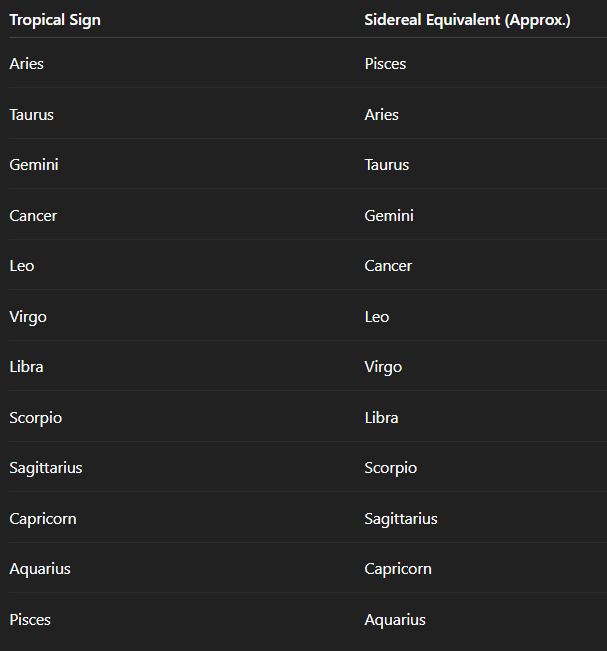
The shift is not personal error. It is simply a different way of measuring the zodiac wheel.
🎯 Which One Should You Use?
There is no right or wrong system. Both tropical and sidereal astrology are valid, rich frameworks with unique insights. The key is to understand their different purposes and find what resonates most with your worldview and goals.
Use tropical astrology if you are interested in:
-
Psychological growth and personality patterns
-
Archetypal themes and symbolic storytelling
-
Life transitions, self-development, and inner reflection
Use sidereal astrology if you are interested in:
-
Karmic themes and spiritual purpose
-
Precision timing of life events and planetary periods
-
Traditional techniques like dashas and nakshatra-based readings
Many people find value in both. You might use your tropical chart for self-reflection and your sidereal chart for practical timing and soul-level insights.
🔄 Bridging the Two Systems
Some astrologers are trained in both systems and use them together. This blended approach can provide a more multidimensional view of a person’s life.
For example:
-
A tropical chart might highlight someone’s expressive Leo nature
-
A sidereal chart might show they are inwardly more like a nurturing Cancer
-
Both may be true and active, representing different layers of identity and experience
Astrology, at its best, is not about choosing sides. It is about learning to read the language of the sky in a way that brings clarity and alignment to your life.
✨ Final Thoughts
Tropical and sidereal astrology offer different lenses for understanding the human experience. One is rooted in Earth’s seasonal rhythms. The other aligns with the stars above. Both point toward truth. The question is which truth speaks most clearly to you.
Explore both systems with curiosity. Let your own experience be the guide. The stars are not here to limit you. They are here to remind you that you are part of something much greater.