

Understanding how current planetary movements interact with your birth chart
Your birth chart is a snapshot of the sky at the moment you were born. But the planets didn’t stop moving when you entered the world and neither did your life. As the planets continue their journey through the sky, they form transits to your natal chart, activating specific energies, themes, and life events.
Planetary transits show the timing of growth, challenge, opportunity, and transformation. They help you understand why things are happening now, and how best to work with the energy.
🌍 What Are Transits?
A transit occurs when a planet in the sky makes an angular connection (aspect) to a planet or point in your natal chart. These connections trigger events, internal shifts, or external developments, depending on the nature of the planet and the aspect.
For example:
-
Saturn transiting your Moon may bring emotional pressure or responsibility
-
Jupiter transiting your Sun may expand your confidence and sense of purpose
-
Mars transiting your Ascendant may energize your personality or physical body
Transits do not force outcomes. They create conditions and opportunities for certain themes to arise. How you respond is always your choice.
🪐 Key Planetary Speeds and Effects
Each planet moves at a different pace, influencing how long a transit lasts and how deeply it is felt.
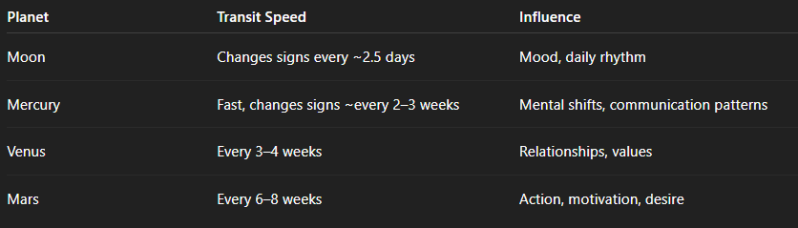
These inner planets affect day-to-day experiences and shorter-term moods or choices.
The outer planets move more slowly and influence longer-term cycles:
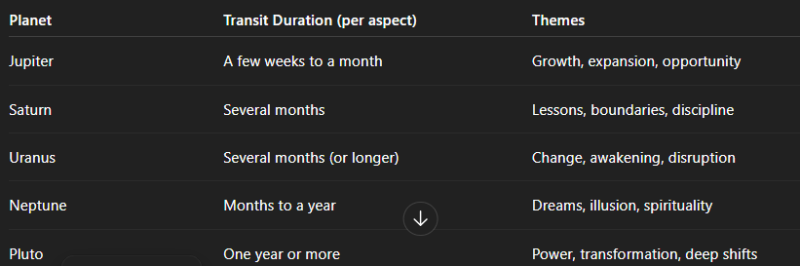
The slower the planet, the more profound and lasting its influence tends to be.
🔑 Types of Transit Experiences
1. Supportive Transits
These include trines and sextiles. They bring ease, flow, inspiration, and harmony. While often pleasant, they may not push you into action unless you intentionally engage with them.
Example: Jupiter trine your Moon may bring emotional well-being, nurturing relationships, or positive news related to home and family.
2. Challenging Transits
These include squares, oppositions, and sometimes conjunctions. They bring tension, obstacles, and transformation. While often uncomfortable, they are powerful opportunities for growth and realignment.
Example: Saturn square your Sun might challenge your confidence and test your endurance, leading to long-term clarity and maturity.
3. Neutral or Mixed Transits
Some transits, like conjunctions, depend heavily on the nature of the planet involved. A conjunction to Jupiter may feel uplifting. A conjunction to Pluto may feel intense and purging.
📅 How to Track Transits
To work with transits, you need to know:
-
Your natal chart (birth date, time, and place)
-
The current positions of the planets (via ephemeris, apps, or astrology software)
-
Which natal points are being activated by aspect
Many people use astrology apps like TimePassages, AstroSeek, or Astro.com to generate transit charts and forecasts.
🧭 How to Use Transit Astrology in Real Life
-
Timing decisions: Start projects when Mars or Jupiter transits your Sun or Midheaven
-
Understanding mood shifts: Identify why you feel off or energized by tracking lunar or Mercury transits
-
Navigating challenges: Use Saturn or Pluto transits to do deep inner work instead of resisting it
-
Planning rest and reflection: Honor slow or foggy Neptune transits with spiritual or creative time
-
Celebrating growth: Recognize when supportive transits bring ease or breakthroughs
Astrology is not about fear or control. It is about alignment with yourself, with time, and with the greater rhythm of life.
✨ Final Thoughts
Planetary transits remind us that life moves in cycles. There are times to act, times to pause, times to let go, and times to grow. By understanding how the planets move through your chart, you gain insight into the larger story unfolding in your life.
Working with transits helps you move through time consciously, not reactively. It empowers you to make meaningful choices and trust the process, knowing that every season has its purpose.